 Reviews

 Proudly American

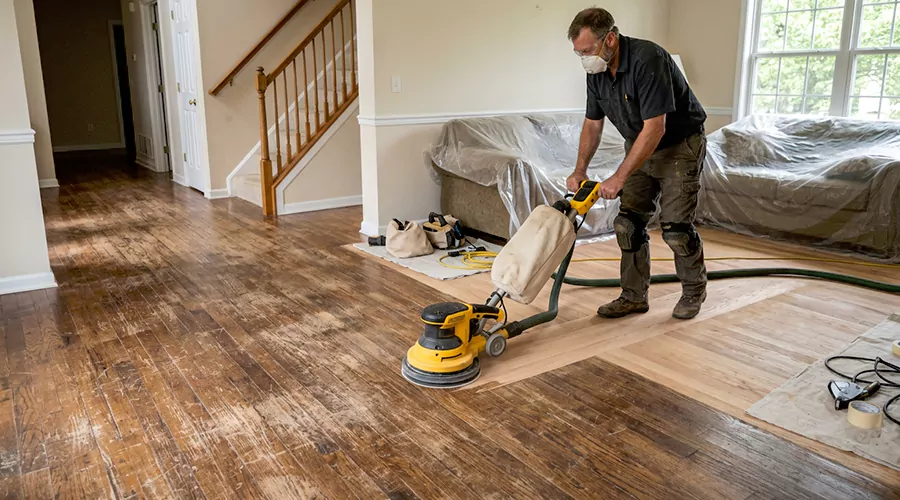
Hardwood floors need resurfacing when the protective finish has worn through or widespread scratches and discoloration have reached the wood below. In 2026, full refinishing typically costs about $3 to $8 per square foot. A lighter screen and recoat can cost less when the wood itself is still protected.
Waiting until bare wood turns gray can make restoration harder. Once the finish is gone, dirt and moisture can enter the wood fibers instead of staying on the protective coating. Water exposure can also damage nearby furnishings, making water damaged furniture restoration necessary when furniture has been affected by leaks or moisture.
The right timing depends on the condition of the floor rather than its age alone. A 20-year-old floor with an intact finish may need only maintenance while a much newer floor with heavy traffic can need deeper work.
What Does Hardwood Floor Resurfacing Mean?
Hardwood floor resurfacing generally means renewing a worn wood floor without replacing the entire flooring system. Depending on the condition, the work may involve lightly abrading the finish or sanding down to bare wood. The correct method depends on whether damage is limited to the finish or reaches the wood.
The term resurfacing is sometimes used broadly. Flooring professionals more often separate the work into two levels.
Screen and Recoat
A screen and recoat lightly abrades the existing finish before a fresh protective coat is applied. The wood itself isn't sanded away.
This approach works best when:
- The floor has become dull.
- Fine scratches remain within the finish.
- High-traffic areas have lost some sheen.
- The existing coating is still protecting the wood.
- You want to renew protection before deeper wear develops.
Full Sand and Refinish
Hardwood floor refinishing removes the old finish and sands a thin layer from the wood surface. New stain can then be applied if a color change is wanted. Fresh protective finish completes the process.
Full refinishing becomes more appropriate when:
- Bare wood is visible.
- Scratches cut into the wood.
- Gray areas have developed.
- Widespread staining can't be removed through cleaning.
- The existing finish is peeling or badly worn.
- Several areas show uneven surface damage.
The distinction matters because sanding removes actual wood. A floor shouldn't be fully sanded when a lighter maintenance coat can solve the problem.
What Are the Signs Hardwood Floors Need Resurfacing?
Floors usually need resurfacing when normal cleaning no longer corrects their appearance and the protective coating shows widespread wear. A single scratch doesn't automatically justify refinishing an entire room. Look instead for repeated damage across traffic areas or evidence that raw wood is becoming exposed.
Watch for these 10 signs.
1. Large Areas Stay Dull After Cleaning
A clean hardwood floor can lose shine as its finish wears down. If dullness stays after proper cleaning, the problem may be the coating rather than dirt.
Minor dullness can often be corrected with a maintenance coat. Widespread dullness combined with bare spots can point toward deeper refinishing.
2. Bare Wood Appears in Traffic Areas
Doorways and hallways usually show wear first because they receive repeated foot traffic. Areas around kitchen entrances can develop similar problems.
Visible bare wood means the protective finish has worn away. Once exposed, wood absorbs moisture and dirt more easily.
3. Gray Areas Start Appearing
Gray hardwood is an important warning sign. The color often develops after the protective coating has worn through and moisture begins reaching exposed wood fibers.
Small gray areas may still respond to sanding. Deep discoloration can require board repair if deterioration has moved too far below the surface.
4. Scratches Reach Below the Finish
Fine surface scratches are normal on wood floors. Deep scratches are different because they penetrate the protective coating.
Try running a fingernail gently across a scratch. If your nail catches in the groove, the damage is more likely to extend below the finish.
5. Water No Longer Beads on the Surface
A healthy surface coating slows water absorption. A worn finish allows moisture to enter the wood faster.
This condition often appears first in high-use areas. Repeated water exposure can then lead to staining or dimensional changes in the boards.
6. The Stain Color Has Become Uneven
Sunlight can fade sections of hardwood over time. Heavy traffic can also create lighter paths through the room.
A full resand allows the old color to be removed more evenly. A new stain can then create a more consistent appearance.
7. The Finish Is Peeling or Flaking
Finish failure can leave rough patches across the floor. Cleaning won't restore a coating that has begun separating from the wood.
Widespread peeling usually calls for more than a cosmetic polish. The failing finish must be removed before a new system is applied.
8. Water Stains Remain After the Source Is Fixed
Dark stains can remain after a spill or leak has dried. Light surface discoloration may respond to refinishing if the wood remains structurally sound.
Severe water damage is different. Boards that are rotting or badly distorted need repair before surface work begins.
9. The Floor Feels Rough Underfoot
A properly finished hardwood floor should feel relatively smooth. Rough fibers can indicate that the coating has worn away and exposed raw wood.
Splintering deserves faster attention because the floor is no longer only an appearance issue.
10. Several Old Repairs No Longer Blend In
Older floors sometimes develop a patchwork appearance after years of spot repairs. Different finish ages can also create noticeable variations in sheen.
Refinishing old hardwood floors can create a more uniform surface when the boards still have enough usable thickness.
Does Your Floor Need Recoating or Full Refinishing?
A floor with an intact protective coating usually needs recoating rather than full sanding. Once damage reaches bare wood, a full refinishing process becomes more appropriate. Replacement should be considered when boards are structurally damaged or too thin to tolerate another sanding.
Use this comparison before choosing a treatment.
| Floor Condition | Likely Approach | Typical 2026 Cost |
|---|---|---|
| Dull finish with light surface wear | Screen and recoat | About $1 to $2.50 per sq. ft. |
| Fine scratches within the finish | Screen and recoat | About $1 to $2.50 per sq. ft. |
| Bare wood in traffic areas | Sand and refinish | About $3 to $8 per sq. ft. |
| Deep scratches or widespread discoloration | Sand and refinish | About $3 to $8 per sq. ft. |
| Severe board damage | Repair plus refinishing | Higher depending on repairs |
| Major structural deterioration | Partial or full replacement | Usually higher than refinishing |
Wood floor restoration doesn't automatically mean sanding every board. The least aggressive method that solves the actual problem usually preserves more of the floor.
Hardwood floor restoration can therefore range from a maintenance coat to major board repairs before refinishing begins.
Can You Test the Finish Yourself?
A simple visual and water-drop check can help determine whether the protective coating is still working. The test shouldn't be performed on an already damaged or unfinished area. Use only a few drops of water in an inconspicuous spot and wipe the surface dry immediately afterward.
First inspect several high-traffic areas under good light. Compare them with flooring beneath a rug or near the edge of the room.
Look for differences in:
- Shine
- Surface smoothness
- Scratch depth
- Exposed wood
- Gray discoloration
- Finish peeling
Next place a few drops of water on an inconspicuous finished section.
If the water remains beaded on the surface, the coating is still resisting moisture. A maintenance coat may be enough if the main problem is dullness.
If the wood darkens quickly, the coating has probably become thin or worn. That area deserves closer evaluation before additional damage develops.
Do not leave water sitting on the floor for an extended test. The purpose is to observe the finish briefly rather than deliberately soak the wood.
How Often Should Hardwood Floors Be Resurfaced?
There is no fixed resurfacing schedule because traffic and maintenance habits differ between homes. The National Wood Flooring Association has historically recommended considering a maintenance coat every three to five years as needed. Full sanding is normally required much less often and should be based on actual floor condition.
A floor in a lightly used bedroom can look good much longer than flooring near an exterior entrance. Pets can also increase surface wear.
Factors that shorten the finish life include:
- Heavy daily foot traffic
- Dirt tracked through entrances
- Large dogs with untrimmed nails
- Frequent furniture movement
- Moisture left on the floor
- Poor cleaning methods
- High-heeled footwear
- Long periods without maintenance coating
Sanding and refinishing hardwood floors every few years would remove wood unnecessarily. Recoating before the finish wears through can delay the need for a full resand.
The condition of the finish should therefore guide the schedule. Age alone isn't a reliable reason to sand a floor.
Can Engineered Hardwood Be Resurfaced?
Some engineered hardwood can be resurfaced but its ability to tolerate sanding depends on the thickness of the real wood veneer. Thin veneers may support only a maintenance coat. Thicker products can sometimes be sanded one or more times before the underlying core becomes too close to the surface.
A screen and recoat doesn't remove the wood layer in the same way as full sanding. This can make it useful for engineered floors with an intact finish.
The decision to refinish engineered hardwood should be made only after the wear layer is checked. Sanding too deeply can expose the plywood or composite core beneath the hardwood veneer.
Refinishing engineered wood floors also depends on whether the product has already been sanded. Each previous refinishing removes some of the remaining wear layer.
Factory-applied finishes can create another consideration. Some coatings require specific preparation before a new finish can bond correctly.
Never assume an engineered floor can be sanded because it looks like solid wood. The construction beneath the surface matters.
What Happens During Hardwood Floor Resurfacing?
A full resurfacing project usually starts with evaluating the floor and repairing loose or damaged boards. The old coating is then removed through controlled sanding when a full refinish is required. Dust is cleaned away before stain or protective finish is applied to the prepared wood.
A typical full refinishing process includes:
- Remove furniture from the work area.
- Inspect the boards for damage or movement.
- Repair loose boards when needed.
- Sand away the existing finish.
- Progress through finer sanding grits.
- Address minor surface imperfections.
- Remove sanding dust carefully.
- Apply stain when a color change is wanted.
- Apply the selected protective finish.
- Allow each coating to dry or cure as directed.
Wood floor refinishing can take about two to seven days depending on the finish system and project size. Additional repair work can extend the timeline.
A screen and recoat is simpler because the floor isn't sanded down to raw wood. The existing finish is lightly abraded so the new coating can bond.
How Much Does Hardwood Floor Resurfacing Cost in 2026?
Full resurfacing through sanding and refinishing generally costs about $3 to $8 per square foot in 2026. Current national estimates put many complete projects around $1,107 to $2,680 with an average near $1,891. Larger homes can cost considerably more because square footage drives much of the total.
The cost to refinish hardwood floors also depends on the wood species and condition of the boards.
| Project Component | Typical 2026 Cost |
|---|---|
| Screen or buff only | $1 to $2.50 per sq. ft. |
| Traditional full refinishing | $3 to $8 per sq. ft. |
| Dustless refinishing | $5 to $8 per sq. ft. |
| Sanding portion | $0.50 to $3 per sq. ft. |
| Staining portion | $1 to $3 per sq. ft. |
| Finish application | $1 to $2 per sq. ft. |
| Typical complete project | $1,107 to $2,680 |
Floor refinishing cost can increase when damaged boards must be repaired first. Staircases or tight spaces can also require more labor.
The cost to refinish wood floors can be lower than full replacement when the existing boards remain structurally sound.
Hardwood refinishing cost shouldn't be compared with replacement based only on appearance. A floor with minor cosmetic wear doesn't need to be torn out simply because its finish looks old.
When Is Resurfacing Not Enough?
Resurfacing isn't the right solution when the problem extends deeper than the usable surface of the flooring. Severe water damage can deform individual boards beyond what sanding can correct. Structural movement also requires repair before any new finish is applied.
Resurfacing may not be enough when:
- Boards are badly buckled.
- Large sections are rotting.
- The subfloor feels weak.
- Deep water damage has blackened the wood.
- Many boards are cracked.
- The floor has been sanded too many times.
- Engineered flooring has a very thin wear layer.
- Large gaps remain throughout the year.
- Termite damage has weakened the boards.
- Structural movement is causing repeated problems.
Cupping deserves special attention. Wood reacts to moisture and can change shape when conditions above and below the floor differ.
Do not immediately sand a newly cupped floor flat. The moisture problem should be identified first because the boards can change shape again as their moisture level returns toward normal.
When Should You Call a Professional?
Professional evaluation makes sense when you can't tell whether the damage is limited to the finish or has entered the wood. It is also helpful when the floor has previous sanding history. Engineered products need particular care because removing too much of the wear layer can permanently damage them.
Consider professional hardwood floor refinishing when:
- Bare wood appears across several areas.
- Deep scratches cover much of the room.
- Gray boards are spreading.
- Water stains extend into the wood.
- The floor has significant cupping.
- You don't know how many times it was previously sanded.
- The flooring is engineered wood.
- Boards need replacement before sanding.
- The finish type is unknown.
- You want to change the stain color across connected rooms.
A flooring specialist can inspect how much usable wood remains before sanding. This is particularly important with older floors that may have been refinished several times.
Professional assessment can also help determine whether a cheaper recoat will solve the problem. Full sanding shouldn't be chosen simply because it sounds more thorough.
How Can You Delay the Next Resurfacing?
Good maintenance protects the finish so daily wear doesn't reach the wood as quickly. Dirt should be removed before it acts like abrasive grit under shoes. Moisture should also be cleaned promptly because repeated exposure can damage both the finish and the wood beneath it.
Use these habits to extend the surface life:
- Sweep or dust mop regularly to remove abrasive debris.
- Vacuum with a setting designed for hard flooring.
- Clean spills as soon as they happen.
- Use products made for the existing wood finish.
- Place floor protectors beneath furniture legs.
- Use mats at exterior entrances.
- Trim pet nails regularly.
- Avoid steam mops on hardwood.
- Don't flood the floor during cleaning.
- Watch high-traffic areas for early finish wear.
- Consider a maintenance coat before bare wood appears.
Keeping indoor conditions stable can also reduce movement in hardwood. The NWFA recommends maintaining indoor temperatures around 60 to 80 degrees Fahrenheit with relative humidity near 30 to 50 percent.
Early maintenance is usually cheaper than waiting for major wear. A maintenance coat can preserve the wood layer that full sanding would otherwise remove.
Conclusion
Hardwood floors need resurfacing when widespread wear moves beyond ordinary cleaning and begins affecting the protective finish or wood below. Light dullness may need only a recoat while bare wood or deep scratches usually point toward full refinishing. Floors with structural damage need repair first. This week, inspect your busiest traffic areas for gray wood or worn finish before the damage becomes deeper.
Frequently Asked Questions
Is resurfacing the same as refinishing hardwood floors?
The terms are often used interchangeably by homeowners. In flooring work, resurfacing can refer broadly to either recoating or full sanding depending on the floor's condition.
Can scratched hardwood floors be resurfaced?
Yes, many scratches can be corrected. Light scratches may respond to recoating while deeper scratches usually require sanding.
How many times can solid hardwood be refinished?
There isn't one fixed number for every floor. The remaining wood above the tongue and groove plus previous sanding history determine whether another refinish is safe.
Can you resurface hardwood floors without sanding to bare wood?
Yes. A screen and recoat lightly abrades the existing finish without removing the wood underneath when the coating is still intact.
Should hardwood floors be replaced when they look old?
Not necessarily. Structurally sound hardwood can often be restored even when the finish looks badly worn or outdated.
Does resurfacing remove water stains?
Surface stains can sometimes be removed during sanding. Deep discoloration or structural water damage may require individual board replacement before refinishing.